Showing posts with label marketing. Show all posts

Friday, September 12, 2008

The Beer Conversation

I hope you will indulge me and allow me to change the regular subject away from wine for a short while.

The subject today is beer. To be specific, it is Stella Artois and their marketing and PR activities. THIS is what I was inspired by!
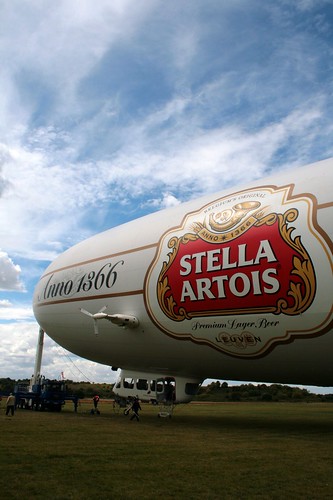


I did not set out to think about beer marketing, but I had been trying to get along to a regular London Bloggers get-together for many months and I had failed 7 times already (that's almost a year of events) so I made a special effort for the summer party.

To help celebrate the event, Stella Artois made the brave, and far-sighted in my opinion, decision to sponsor the event. Not only did they pay for drinks, but they also offered a quite unique prize - a trip for up to 6 bloggers in their Star Over London airship (or zeppelin) as seen above. Each of these seats cost up to £360, so it was no small prize!

Stella Artois managed to tie in this prize to their sponsorship of "Love Your Local", a campaign they are supporting to highlight pubs that are at the heart of their community. To win the bloggers' prize we had to describe what we liked about our favourite local. I happen to have a great local pub (The Honor Oak), so it was no effort to write about them - and it so happens that I won one of the prizes.

[You can see my pictures here]

I also discovered that, as well as their long-standing and well regarded television commercials, they have a new interactive site with a game and other goodies (not sure about the game - it looks wonderful, but is it a game or a movie?) that includes a great collection and presentation of their adverts (I think these are the cinema-length versions).

It is a sign of a good campaign that you can conduct several different activities but still manage to tie them together, keeping the brand profile high.

Stella Artois emerges as a well recognised brand that cleverly manages to sell itself as a "premium" brand whilst still managing to compete on the mass market in pubs and supermarkets (i.e. it still discounts!). As far as wine is concerned, only champagne has managed to achieve this.

Wouldn't it be wonderful to see a similar branding concept in the wine business?

There are many reasons you won't see a wine brand pay to brand a zeppelin or shoot some of the most beautiful cinematic ads, chief of which is that none can afford it, but the impressive link up between the promotions, and the single-minded (although no longer "Reassuringly Expensive") and cleverly humorous presentation is something that would be wonderful to see.

[I ought to point out that Stella Artois is not immune from criticism either, with regard to its branding, but I don't think it negates the point that wine brands who want to succeed, as well as surviving for somewhere between 82 and 642 years, can learn from this sort of consistent branding]

Monday, January 21, 2008

ABCs never knew what hit them

Some time ago there was a lot of excitement over the fact that there are two competing films being made in Hollywood about the same event, The Judgement of Paris.

I'm sure that if you are reading this site you are already acquainted with this story. "Shock! Horror! Respected wine judges select Californian wines above French in blind tasting!"

It probably seems strange to people starting out on their wine discovery journey today that there was a time when 'New World' wines were struggling for recognition (although the term "Fine Wine" is still very much dominated by French wines). However, 1976 saw a sea-change. I won't bother commenting further on this here as it has been done to death before and will be again once these films come out.

I thought I'd comment on the films themselves. Much will be said in the official wine journals and blogs about how closely or not these reflect the actual event. I think this article covers most of the common points.

What I think is interesting will be the fact that 98% of those who watch the films will not care. However, as the Sideways effect has shown, some of the results of a film involving wine can be long-lasting even if unintended.

What I think might emerge from this, and I'm sure that there are plenty of people out there who hope it will, is a rejuvenated interest in the Chardonnay grape.

The first, and probably more light-hearted of the two, is Bottle Shock ("The French Never Knew What Hit Them" - including a tasteful image of wine bombs being dropped on the Eiffel Tower). It will focus on the winning white wine, a Californian Chardonnay from Chateau Montelena. If it gets people thinking positively about Chardonnay again, then this can only be a bonus, but lets hope the film has a little more integrity than the strapline suggests (I'd rather not see another "A Good Year" - it did very little for wine, romance, comedy or even film for that matter).

Let's hope that less detailed historical accuracy is made up for in a plot that engages its audience in a love of wine, wherever it may be from.

The second film is still in the works, but will focus on the winning red wine, the Cabernet from Stag's Leap, and I guess we will have to wait to see more about this, if and when this finally makes it out.

Who knows, but in 18 months time we may be talking about a new ABC movement in consumer drinking patterns. Maybe, instead of Anything But Chardonnay, we might have "Another Bottle shock Convert"

Friday, January 18, 2008

Stormhoek News & Speculation

Well, it looks like things are on-track for keeping the Stormhoek brand alive, if not the whole of Orbital as a company.

I'm sure we'll know more early next week once due-diligence is complete, but it is fun to imagine where they will end up.

Just imagine: Wouldn't it be fun to see it taken over by someone outside the wine business, probably by a tech company trying to reach the young, blogging, tech-savvy audience that already knows & loves the brand?

Why should they?

Well, a wine business will need to make a reasonable profit from it to justify the take-over, and we know how hard that is. For a well-funded tech business, this sort of investment would be peanuts, and so even if it made no profit at all, it would save them $/£ millions from their advertising budgets, money that they would otherwise spend anyway.

Just a bit of fun. I don't expect anything like this, but it would be a great Wine2.0 story, wouldn't it?

"Major Tech Company buys Social Object in a Bottle"

Friday, January 11, 2008

Stormy waters for Stormhoek

Lots of interest in the story about Stormhoek and Orbital going into administration that I posted recently, so I thought I would update it with a few more thoughts.

My first observation is that there has been a deafening silence from Hugh MacLeod on the subject of Orbital's problems. You'd think that the uber-blogger and chief communicator might have something to say on the subject so I am guessing that either a) he is so thoroughly ****ed off that he dare not discuss it or b) - much more likely - that there is stuff happening behind the scenes and he is waiting for that to be made public. I certainly do hope it is the latter.

Secondly, Alastair brought up the issue of the 4P's of Marketing (a subject I have covered before myself before) in the comments.

I do think that Stormhoek did manage to have a good Product, at an attractive Price and had managed to get reasonable distribution (Place) for the wine - and of course they were famous for the Promotion. Here was a brand NOT using Price as their main driver - hurrah!

The main reported reason for the failure of the business was a poor decision to upset a retailer by selling their wines cheaper to a competitor, resulting in them being delisted. Whether this is factually correct or not I do not know, but it reminds us that retailers have power over such young brands - and that without the P of Place/Distribution none of the other elements mattered enough, and the business suffered.

However, I would also suggest that there is another way they had suffered a little lately as Alastair's story demonstrates (see comment number 5). The focus had moved too far towards packaging and the image. There were regular label changes, including for Valentine's Day, special runs with new labels for facebook groups, awards dinners and Microsoft, etc. I'd suggest that all these distracted from the main business objectives and did not focus enough on getting fans to put their money where their browsers were and go out and buy the wine.

A small company cannot cope with lots of different labels and dispatching tiny lots of wines all over the place (for free!!). The key is focus, and in a competitive market like wine, to minimise costs. Instead, they started upsetting their fan base by fragmenting their product offering and making it harder to deliver on their promises.

The Wine Conversation needs to be as general and free-ranging as possible, and no brand could, or should, control it. Anyone can join in and so become interested in wine, whatever their angle is on the subject. However, as Josh pointed out, a winery or brand needs to sell wine in order to survive, and their conversation must ultimately lead people to the cash register.

I hope that Stormhoek 2.0 gets back to basics and uses its indubitable communication skills to get their product selling again.

More thoughts soon I'm sure when more news comes out.

[UPDATE: More news out now. See here. The Administrator is "optimistic" of reaching a deal next week.]

Sunday, November 25, 2007

Wine and Photography - some thoughts

Andrew Barrow from Spittoon is, as I have said before, a great photographer of wine 'occasions', particularly setting them off against food matches. Check out his photos here. He also pointed me to a friend's photos here.

He and I have had a brief conversation about this some time ago, and I thought I would share my issues with this subject here in case others have any suggestions.

If you ask someone for a "wine" photo, you will get:

- a bottle shot, with or without props
- a vineyard shot
- a glass of wine (funny angle not required); swirling or dripping extra
- a smiling couple/group at a table with glasses raised

However well executed these shots are (and some are better than others), they have been done before by someone else. What is happening in 2007 with wine that we want to communicate? Is there nothing different today than there was 2, 10, 20, 50 years ago? I think there is, and we need to think about the visual language of how we get this across.

Let me give a comparative example culled from about 45 seconds searching on flickr.com

If wine were ... snowboarding, then this is the photo we are using (This photo by Anh Quan). There is nothing wrong with it. It shows boards, the design alternatives and the set up is fine.

However, snowboaring enthusiasts might use this type of shot (Photo by T A K K):

Relevant, active, engaging, atmospheric, fun, modern, youthful, ... good!

You might even go so far as saying that if you removed the board from the photo, there are still enough clues for the target market to say "Snowboard!" (or whatever a cool snowboarder actually says).

This is exactly what the perfume business and soft drinks markets already do. Perfumes are all about beautiful people being terribly attractive.

Soft drinks are the same. A can is boring, but Wayne Rooney draining a can after a tough game whilst condensation drips from the can or bottle is not. Of course we cannot, by law, do many of these same things for wine at least in the EU, but the concepts are there.

So, if snowboarding or perfumes were wine, what photos should we be taking to make it relevant, active ... and all those other nice words up there?

Now, Chateau Petrogasm has attempted to move in this area, although not directly. Their concept is to link a photo (or an image more generally) with a tasting note. This is radical, and fun, but it is about the taste of the wine. I am still thinking a little more broadly about how photography might capture the essence of a wine brand.

Tom Wark at Fermentation also mentioned a similar issue recently, although relating to the graphics for the entire catalogue and not about a single wine or brand.

I believe that this area is ideal fodder for more creative bloggers who have a decent artistic streak and mastery of a camera.

Question: How would you 'capture' a wine brand WITHOUT showing a bottle, a glass, winery or vineyard? Has it been done? Any suggestions for specific brands (polite only please!)?

And then (you knew it was coming), how might we communicate the Wine Conversation and therefore the role of wine in our culture(s) in general using photography (bottles and glasses allowed this time)?

Monday, July 09, 2007

Cost of wine on the High Street

Once again Peter has challenged me, so here is my response on excess drinking and the cost of business. Thanks Peter!

I mentioned that I thought the Threshers "3 for 2" campaign was a good thing, to which Peter asks:

"So you don't agree with recent claims that such offers encourage binge drinking?"

In general terms no, I don't agree that a "3 for 2" encourages binge drinking. I am still of the opinion that all consumers (who can legally buy alcohol) should be treated as reasonable and responsible adults. I really don't like this government's campaign to control personal decision-making in all sorts of areas and not just alcohol.

Do you think that Majestic insisting on people buying a case of 12 is 4 times as bad as Thresher? Of course not. Binge drinking is an issue I'm sure, but restricting the sale of these products is not the answer.

So, assuming people can buy more than one bottle without drinking them all at once, why should we encourage this?

"The real problem with Threshers is that the single bottle price is so inflated. With Tesco, their instore prices are equivalent to the discounted Threshers price, and so an additional 30% is a deep discount."

The issue is cost and convenience. Threshers operates out of small shops on high streets. They specialise in certain types of wines, those the consumer is familiar with and wants to buy fairly regularly. This means that they are not competing with independent wine specialists whose niche are small production, probably higher cost wines, but directly with the supermarkets who sell the same wines. Of course the supermarkets can afford to get prices very low because they have bulk buying power and other economies of scale.

So where does it leave Threshers? We cannot really expect them to be able to sell the exact same wine as Tesco for the same price can we? Why should they? We really ought to be prepared to pay a premium of some sort to be able to buy that single bottle of wine on our way home without having to negotiate all the aisles and checkouts of the supermarket.

They could have left it at that, and maybe survived, but the pressure would have been ongoing (arguably what is happening to Oddbins). So instead, they have a contract of sorts with their customers that goes something like this:

"If you are prepared to buy in slightly greater volume (thus increasing our cash flow and turnover of bottles), we will reduce our total price to you to be in line with those places you might otherwise shop"

That is obviously too complicated a message, but anyone can understand "3 for 2" and it is therefore a good marketing concept. Do I begrudge them trying to survive? Not at all. You can still buy that single "emergency" bottle on the way to the party, or after a tough day or whatever. If you think that premium is too much, you can still go to the supermarket instead.

No-one criticises Majestic in the same way for a vaguely similar model, quite the opposite. In fact their prices are also more or less in line with other retailers but only because they demand that you buy in volume. They won't even allow that single bottle purchase. Surely this is something we could praise Threshers for?

When Tesco, Sainsburys et al offer a further 25% or 30% discount, Threshers and other smaller retailers simply cannot compete and still make money. However, they have to find ways to stay in touch as they still need to trade. Where I have the problem, as I have raised elsewhere, is when they try to do so by 'bamboozling' customers by talking about percentage discounts instead. I would like to see them try and find a differentiator that was not price and discount driven instead (as discussed many moons ago here and here) - it seems a sensible suggestion for longer term differentiation.


I should state for the record that indirectly I am involved as a supplier to Threshers (as well as Tesco, Sainsburys, Majestic and many others), but that my views on this are quite definitely my own and presented in the spirit of improving wine knowledge and discussion rather than promoting or knocking any specific retailer or wine.

Wednesday, July 04, 2007

Varietal labelling - some clarifications (Varietals: 3)

Peter May, of the Pinotage Club and also the author of a site and book about wine labels that is definitely worth checking out, made some comments on my pet subject which I thought I ought to post here to clarify a few points.

You can read his comments on my posts on varietal labelling here. In response, I would say:

First of all, I have nothing against listing the varietal make up of a wine. Whether this should be 85% or 100% of the wine is open for debate but it isn't the fact that it is listed, but rather that the wine packaging focuses too heavily on this one element to speak to the consumer.

Second, with regard to the "flaw in the argument", I would have to disagree. It is EXACTLY because Stellenbosch, Napa and Margaret River cannot be linked to one style that I argue that the old world countries SHOULD do more to focus on regions. Although this is often regarded as negative, this could be a positive thing. A (protected) regional name is unique, uncopyable, defensible. However, it must be made to be meaningful through proper quality systems and common agreement otherwise it will be eroded.

If, as many believe and you seem to agree, the right (or even best?) varieties are planted in such regions, then there is no need to change the product itself, but maybe focus on the other elements, especially communication. They may not have done it well to date, but that is not in itself a reason not to do it.

I agree that my points were made with a very "old world" view of the world, and you rightly point out that the same argument does not necessarily transfer to New World regions. However, there are many regions of the world that are trying to replicate this model, so there is a future for it. Hunter Semillon? Barossa Shiraz? These regions do try and associate style with the regional name.

Let me make it clear that I am not advocating removing the varietal information from labels. I just think that marketers should be willing to consider relegating it a little further down the order of importance. The current mantra in the industry seems to be "varietal above all else" and I'm only trying to raise a possible counter argument.

I may, of course, be totally wrong.

Isn't that the wonderful thing about blogs?

Wednesday, June 13, 2007

Wino-dynamic

How is a consumer expected to care about Bio-dynamic or Organic wine?

According to a study, consumers are confused. I wonder why?! With regard to why they purchase:

Biodynamic is less important than Organic
Organic is less important than the vintage
Vintage is less important than the winemaker
Winemaker is less important than the region
Region is less important than the country
Country is less important than the Varietal
Varietal is less important than the price
and finally,
Price is less important than the "deal" or "offer"

How is the average wine buyer to even start to consider whether the wine is either organic (which they at least have heard of) or bio-dynamic (which they certainly haven't)? They aren't even quite sure if the varietal name they have heard before is red or white.

The problem with marketing in the wine trade to some extent is explained by the fact that the differences, if any, between any wines are all at the top of that list, and therefore far beyond the interest levels of the consumer.

Therefore we have the following options:

Give them a(nother) deal
Join the me-too brigade focused solely on the varietals
Spend millions in the hope to increase wine "education & understanding" amongst consumers
Give them another, very different, reason to buy YOUR wine

Stormhoek are doing this last one. Magners have done it in cider. Levis did it for jeans.

As Hugh says, "go after the magic".

Unfortunately, in the commercial arena, bio-dynamics are still just hocus-pocus, not magic.

Wednesday, May 30, 2007

A question

A question for a dreary Wednesday morning:

(I am trying to get my head around this and I am sure many people will have different views)

How important is the varietal on the wine label?

Any thoughts? Has anyone come across any diverging views?

Monday, April 23, 2007

Copy cat actions

Thanks to mark e who left me a comment on my post about motivation.

"btw I suspect the trick is to get people doing something neat that others can copy. The enormous social signal of a pint glass with ice in it is just such a behavioural meme.

On wine suggestions:
Hugh at http://www.gapingvoid.com and his Stormhoek have blended something to suit the ice-cube usage occasion."


That story came out the day after I posted my thoughts I think (I regularly read gapingvoid, although he is more focused on Microsoft's Blue Monsters at the moment). Copying an action is one thing, copying a "trademark" action is another, as it will always strike the consumer of the copycat that they are being manipulated in this second case, possibly making them re-evaluate the original.

Some of the pre-teen-friendly pop groups succeded by creating dance routines that the teeny-boppers could copy (e.g. Steps?). Many others followed, with greater or lesser success, but ultimately it becomes part of the marketing repertoire and therefore loses its power.

When it comes to alcoholic drinks, I assume that the target markets are probably aware of this and therefore that the "tail" of this copying action will be short, however I may well be proven wrong.

I don't know this, but I imagine that "Herd" memories are short and that is why we keep making the same mistakes, so I guess ice manufacturers are going to be in business a little while longer.

Wednesday, April 11, 2007

Appealing wine drinkers

The audience that could potentially have the most appeal to wine makers and retailers are those aged 20-30 who could then develop their interest in, and expenditure on, wine for the rest of their lives.

So how does wine manage to appeal to this appealing audience?

This is one of the things I am trying to think about on this site so I was interested to see that it was the main headline of research carried out for Vinexpo (the world's largest wine show in Bordeaux every two years) with young people in the UK, US, Japan, France and Belgium.

(According to my sources - Harpers and OLN) Their recommendations were:
  • provide a younger image - moving wine away from the drink parents enjoy

  • change the perception that it is a drink associated with higher social classes

  • demistify wine

  • provide guidance

Well, I'm not greatly enlightened by this and if this is new thinking for the French, then they are a little behind what is happening elsewhere already.

To be fair, there are a few things that are interesting, but contradictory.

They say, for example, that young people say they are interested in wine because it is seen as "sophisticated", but then they talk about demistifying it and changing its image to something more youthful. A very fine line to walk there. Surely it is better to build upon the existing image and make it relevant, not pop the bubble of wine's mystique?

Also, they mention that young drinkers like traditional packaging (not tetrapack?) but that they also like branded wines that are not too obviously targeted at the young. Agreed! We are all much more sophisticated consumers of marketing messages these days and wine has to fight its corner along with Nike, Coke, Playstation, Nokia, et al.

Finally, they say they find the category confusing, so they want more varietal labelling. This is something I have trouble with as the two are not strictly related. It would be awful if, in their desire to chase this market, retailers chose only varietal wines that conformed to a specific taste profile. Does a varietal label really give more information, or is it just another "brand"?

I think there ought to be a campaign called "Variety, not Varietal!" (maybe there already is?). I think I should deal with this separately in more detail in future.

The thinking still seems to be that individual wineries and retailers can shape this market, but I think that this is unlikely. As I said above, there are a lot of competing demands for the attention of these young adult consumers from brands not just in drinks, but in every moment of their waking life. How is wine to be relevant and interesting to them?

What wine needs is a real, reasonable, fun and fashionable conversation to emerge concerning wine that 20 somethings can participate in, learn from and then use to improve their experience of drinking wine. That will need a much more concerted campaign by everyone involved in wine. Or lots of luck!

Wednesday, March 21, 2007

Marketing Innoculation

So Threshers and Stormhoek are at it again (no I will not link to it, but I suspect you can find it easily enough) - you can read my previous views here and here.

Having just spent 6 weeks trying to rid my body of an infection, I don't have the energy to fight a marketing "viral" campaign too, but I think that the consumer "body" will be better able to resist it this time around - although I may be wrong.

My own view is that resistance is low at Christmas, but that at the moment the word of mouth element will be sufficiently dilute for it not to take control. It would be amazing if it did, but there are probably enough deal junkies and gapingvoid 'disciples' to spread the word. However, how many times can Hugh do this before he ruins his own credibility and that of the brands he works on?

Let's wait and see. I suspect the answer will be inconclusive, with a rise in sales to justify the action but not nearly the same impact, vindicating the opponents.

Wednesday, March 07, 2007

New Packaging - Wine Tetrapack

I have been suffering from one of the worst chest infections in my life and have been unable to taste or even think about wine clearly for the last month, so apologies for the extended silence.

As I was shopping for milk in my local co-op convenience store the other day, I came across one of the latest novelties in packaging for wine. The tetrapack.

I have seen the format before, (I am thinking of French Rabbit from Boisset) but I hadn't actually seen it on shelf before. I was intrigued to find this in a small store in my local area, so I bought it for curiosity's sake. Unfortunately, when I opened it to try it, I couldn't taste it, so I have no comments on the quality of the wine.

The wine in question is Andrew Peace's masterpeace Australian Chardonnay, launched at the Australia Day Tasting in January.

Is this the future for wine? Let me think about some pro's and con's first.

On the positive side;
  • It weighs less so it is cheaper and more environmentally friendly to ship

  • The opaque carton protects the wine from the harmful effects of bright sunlight and UV

  • It is a sterile, sealed environment unlikely to become "corked"

  • It gives greater surface for marketing messages and useful information

  • It is easier to store; no wine rack required

  • I believe it is supposed to be recyclable

  • It is not all that different from the bag-in-box format we are already familiar with and which is becoming more popular


  • On the negative side;
  • It has been done before for the cheapest of the cheap wines in the days that these were undrinkable (things have improved even at this level in the wine trade), and is therefore tarnished with this perception

  • It is still made from plastic and various metallic compounds, so how environmentally friendly can it be?

  • You get no visual clues at all about the wine. Think of the attractions of rose wines, deep gold sweet wines, etc. All wines will look the same, or at least the colour the marketer/printer want you to think it is

  • Bottle shapes have always been a differentiator, not just on weight for 'better' wines, but classic regional shapes like the tall bottles from Alsace, or embossed Chateau-neuf-du-pape

  • It is not all that different from the bag-in-box format we are already familiar with


  • None of the pros and cons immediately jump out at me as "killer" reasons for or against. This packaging is likely to be used only for cheap, young wine to be drunk immediately, so convenience will matter. And if, on balance, it is more environmentally friendly to produce and dispose of, then even better.

    So, is this the future of wine? I don't consider myself an old-fashioned wine purist. I am all for the screwcap and other modern closures for example. However, I am not convinced by this format for the simple reason that it further reduces wine to a mere convenience beverage, one that happens to contain alcohol and be made from grapes.

    If we are to educate consumers about responsible drinking, encouraging them to drink wine but to do so in moderation and hopefully at a quality level that will bring them pleasure, then it is important we do not "dumb it down" too much.

    Wine branding is not only about building a name and image for the producer, or even of the region, but for the product category itself. This isn't about being elitist (although I recognise it could sound that way), it is about building a sensible Culture of Wine. Quality packaging is integral to that I think. That isn't to say we should stick to glass per se, but I would like to see something better differentiated than a carton.

    Unfortunately, I don't think this is it, but it is certainly something to ponder further.

    Sunday, February 04, 2007

    Kids must drink


    A strange sight greeted me the other day in Sainsbury's.

    It might have been there a while, but I had not noticed. However, when I did, it struck me as quite odd, but relevant. It was well away from the wine aisle, and not even a gondola end promotion. It was in the chiller cabinet. The fresh juices to be precise.

    I was picking up some apple juice for my daughter when out of the corner of my eye I spotted the word "Merlot". I knew something wasn't right as I had already glanced around the regular haunts for wine in this supermarket. On the eye level shelf in the chiller cabinet were two different plastic bottles of grape juice. One labelled "Chardonnay", the other labelled "Merlot". Apparently these are grape juices made from these varietals somewhere in "the vineyards of Italy".

    All of this was quite shocking.

    First of all, we are advertising the grape varietal names most often associated with alcoholic dinks, namely wine, to the major consumers of grape juice - kids.

    Secondly, I always assumed that grape juices could only be made from table grapes, not those destined for fermentation, as the former are sweet, juicy and less 'complex'.

    Is this a good thing? Well, I clearly remember growing up drinking "my wine" when my parents had theirs, so this is not new, although that was labelled simply as "Welch's grape juice" (I still remember this - odd). It also means, in theory, that grape growers in certain areas have a new potential outlet for grapes that cannot be sold as wine, but that I would need to research more as I still can't quite believe this is a simple case of not fermenting the grapes.

    In Spain, younger drinkers do like their glass of "mosto" (must) so I guess this is our equivalent, even if ours has to be packaged, shipped, branded and sold for a lot more.

    It does indicate, though, that these grape varietals have now been so ingrained in our national consciousness that they can be used for products that are not wine.

    Varietal labelling has come a long way in 30 years.